New Zealand

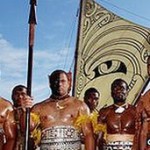
New Zealand, a wealthy Pacific nation, is dominated by two cultural groups: New Zealanders of European descent, and the minority Maori, whose Polynesian ancestors arrived on the islands around 1,000 years ago.
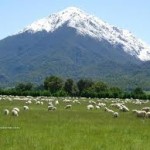
Agriculture is the economic mainstay, but manufacturing and tourism are important and there is a world-class film industry.
New Zealand has diversified its export markets and has developed strong trade links with Australia, the US, and Japan. In April 2008 it became the first Western country to sign a free trade deal with China.
At a glance

- Politics: John Key led the National Party to victory in elections in 2008 and 2011
- Economy: The country officially went into recession in September 2008, for the first time in ten years
- International: New Zealand troops have taken part in regional peacekeeping efforts and have been deployed in Afghanistan
British sovereignty was established under the 1840 Treaty of Waitangi – a pact between Maori chiefs and the British government over land rights.
The treaty gave rise to land claims which culminated in the “New Zealand Wars”, a series of skirmishes between colonial forces and Maori in the North Island.
The government awarded money and land in settlements during the 1990s, but the land issue remains controversial.
In 1984 the government embarked on a dramatic and controversial economic reform programme, which lifted controls on wages, prices and interest rates and removed agricultural subsidies.

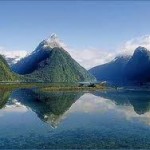
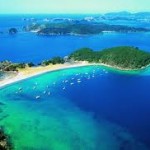
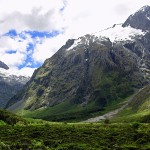
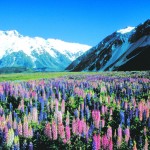
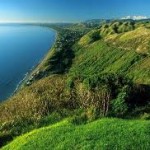
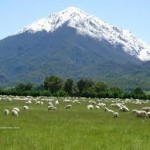
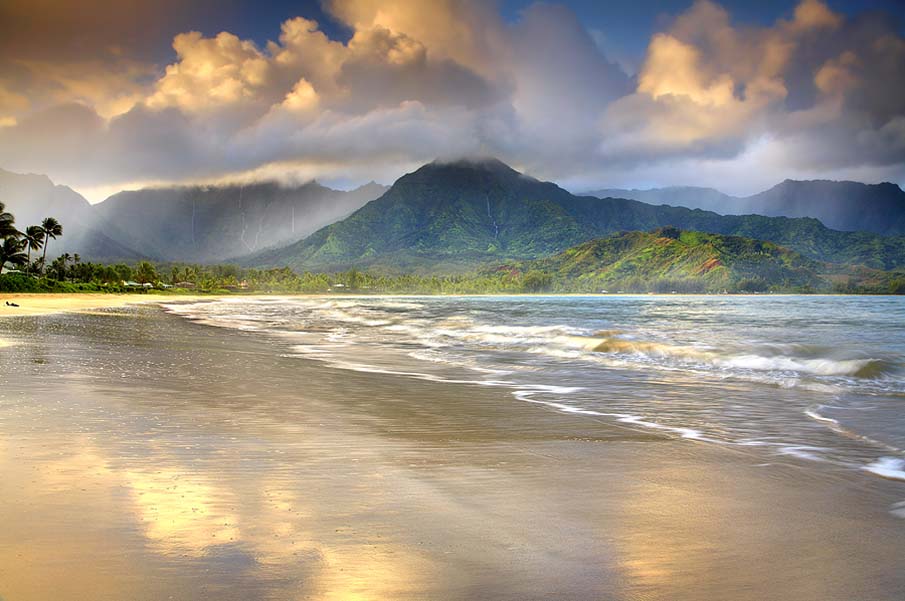
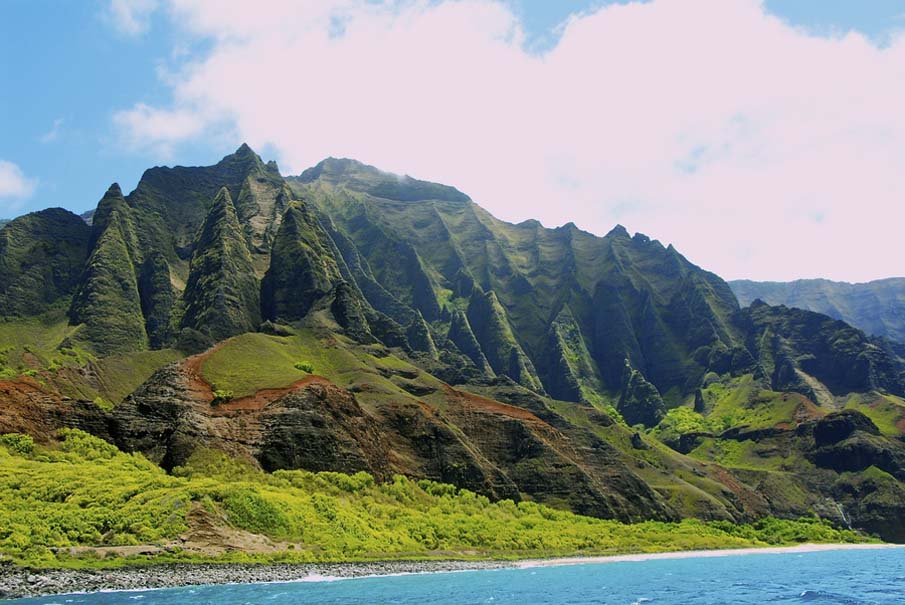
The landscape is diverse, and sometimes spectacular. This has fuelled tourism; visitors are drawn to the glacier-carved mountains, lakes, beaches and thermal springs. Because of the islands’ geographical isolation, much of the flora and fauna is unique to the country.
New Zealand plays an active role in Pacific affairs. It has constitutional ties with the Pacific territories of Niue, the Cook Islands and Tokelau.
Its troops served in East Timor when violence broke out in the territory in 1999 and were part of a multinational force intended to restore order to the Solomon Islands in 2003. Further afield, New Zealand forces have backed peacekeeping and development efforts in Afghanistan.
But its anti-nuclear stance – including a ban on nuclear-powered or nuclear-armed vessels from its waters – put it at odds with the US in the 1980s.
A significant amount of New Zealand’s electricity is generated by hydropower sources and the country has a range of renewable energy sources at its disposal.
Migration patterns have changed, with most incomers coming from Asia and Pacific island states, rather than from the UK and Australia. Officials estimate that Asians will make up 13% of the population by 2021 from about 9% in 2009.
New Zealand Facts

- Full name: New Zealand
- Population: 4.3 million (UN, 2010)
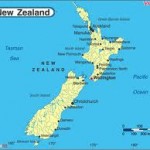
- Capital: Wellington
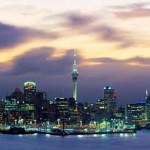
- Largest city: Auckland
- Area: 270,534 sq km (104,454 sq miles)
- Major languages: English, Maori
- Major religion: Christianity
- Life expectancy: 79 years (men), 83 years (women) (UN)
- Monetary unit: 1 New Zealand dollar ($NZ) = 100 cents
- Main exports: Wool, food and dairy products, wood and paper products
- GNI per capita: US $29,050 (World Bank, 2010)
- Internet domain: .nz
- International dialling code: +64
New Zealand Leaders
Head of state: Queen Elizabeth II, represented by a governor-general
Prime minister: John Key

John Key led the centre-right National Party to victory in the November 2008 general election and again in the November 2011 elections.
His party’s 2008 victory ended nine years of Labour-led government.
The National Party fell short of a parliamentary majority in both the 2008 and 2011 elections and was compelled to form a coalition with other parties.
Born in 1961 and brought up in relative poverty by his Austrian-Jewish immigrant mother after the early death of his father, Mr Key became a currency trader and has acquired a substantial personal fortune.
He rose to be head of foreign exchange at Merrill Lynch in Singapore, and served as a member of the Foreign Exchange Committee of the New York Federal Reserve Bank in 1999-2001.
National Party president John Slater encouraged him to enter politics in 2001, and Mr Key was elected to parliament the following year. He was appointed opposition finance spokesman in 2004, and became party leader in 2006 after Don Brash resigned over allegations of election-funding irregularities.
Since taking over the party, Mr Key has positioned it more on the centre ground. His first speech as leader pledged a future government to measures to prevent the creation of an “underclass”, and he has said that reducing greenhouse gas emissions by 50% in the next 50 years will be a priority.
New Zealand has a single-chamber parliament, the House of Representatives, which is elected for a three-year term. Coalition governments have been the norm since proportional representation replaced the “first past the post” electoral system in 1993.
16 July 2012 Last updated at 11:04 ET
New Zealand Media
 Government-funded Maori TV aims to revitalise Maori language, culture
Broadcasters enjoy one of the world’s most liberal media arenas.
The broadcasting sector was deregulated in 1988, when the government allowed competition to the state-owned Television New Zealand (TVNZ). Privately-owned TV3 is TVNZ’s main competitor.
Satellite platform SKY TV is the leading pay TV provider. Freeview carries free-to-air digital terrestrial and satellite TV.
The New Zealand Herald newspaper has the biggest circulation.
Some 3.6 million New Zealanders – more than 80% of the population – were online by December 2011 (InternetWorldStats).
Country profiles compiled by BBC Monitoring








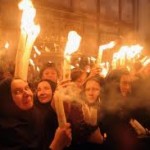
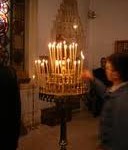
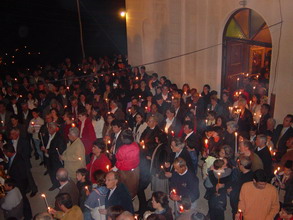 I never really cared much about the church ceremonies leading up to Easter, with the exception of the candle lighting ceremony that begins at 11pm on Saturday night and ends after midnight when all the candles held by the people in and around the church have been lit by the holy flame and they begin their journey home, each person holding one. To me there is something beautiful and magical about this. I think it is the most important ceremony in Christianity because it affects believers and non-believers. To see the church begin to glow brighter as each candle is lit and then the masses of people walking through the city streets or the towns and villages fills me with a spiritual feeling of being part of something bigger than myself. Even in the USA when I have gone to the tiny Saint Barbara’s church in Durham where people take their lighted candles and get into their cars and drive home, there is something special about being on the highway after midnight on Easter Sunday and seeing the interior car next to you aglow.
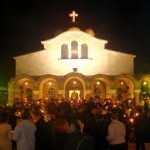
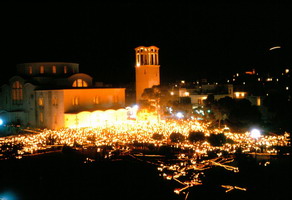 Lately though I have taken an interest in the whole Easter celebration, not just the Easter Sunday ceremony and then the roasting of the lamb and drinking wine which of course is my favorite thing about Easter. For one thing people ask me about Easter all the time and by telling them that for me it’s all about lighting candles, eating a lamb and getting drunk they may think I am some kind of pyromaniac, gluttonous drunkard, which is only part of the story. I actually come from a very religious Greek Orthodox family. However my father was the least religious member of the family, a socialist agnostic who took us to church twice. Once when our grandmother died and once for Easter in 1963 at Agia Thomas in Goudi, Athens. It was this Easter service that had a profound affect on me. We lived in an apartment right across the street from the church and from our balcony we could see the people leave the church with their candles(photo) and the fireworks at midnight. Soon afterwards all the people left and walkied like a candle-lit parade through the empty streets of Athens while the bells rang all over the city. From another window we could see a procession of candles making its way down Mount Lycavettos. A psychologist would call this an imprint. I have loved Easter ever since.
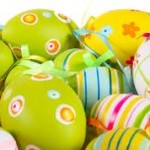
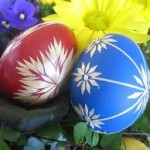
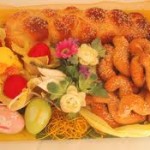
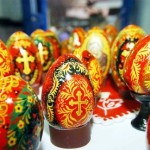
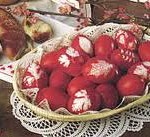
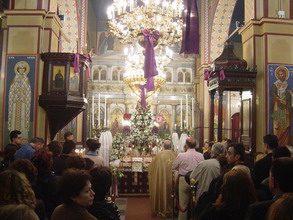 The week of Easter begins on Palm Sunday and there are church services everyday commemorating the last week in the life of Jesus Christ. The evening services are the most well attended of course, except for Wednesday when the Service of the Holy Unction is held in the afternoon. On Thursday morning the service commemorates the Last Supper and the Betrayal of Christ. This is the day that the hard-boiled eggs are dyed red, signifying the blood of Christ, and the Easter bread, called
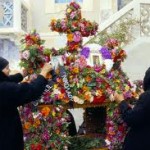
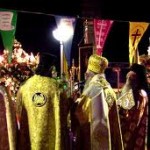
 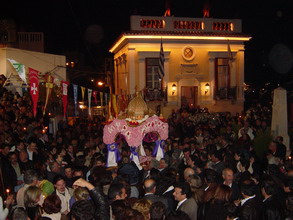 From the point-of-view of a spectator from Friday it starts to get very interesting. The nails holding the figure of Christ are knocked off and the figure is taken down from the cross and wrapped in a white cloth. A large piece of cloth, embroidered with the image of Christ, called the epitaphios which has been decorated with flowers by the girls through the night, is brought into the church where it is sprinkled with rose-water and more flower petals are thrown upon it. The bells of the church begin to toll and all the flags in Greece are lowered to half-mast in while women in the congregation weep in mourning for the dead Jesus. In the evening a funeral service is held and at about 9pm the epitaphios is taken from the church and with the bells tolling mournfully, is carried through the streets in a solemn procession. In cities, towns and villages with more than one church the epitaphios parades may join together at certain points. In Hydra the epitaphios is taken into the sea at Kamini as it is in Tinos at the church of Saint Nicholas at Kalamia. In some places an effigy of Judas is burned while in others Barabbas is. In Skiathos the epitaphios service begins on Saturday at 1am and the procession through the town begins at four in the morning as it does in Zakynthos. On the island of Kea in the village of Ioulida the three congregations meet in the square with their epitaphios after taking different routes through the village. (photo)
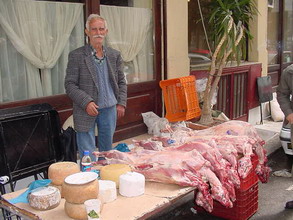 Meanwhile around Athens there is all sorts of activity this week. The central market has thousands of lambs of all sizes and in Psiri the annual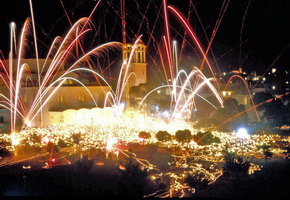

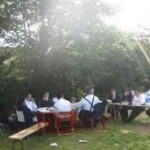
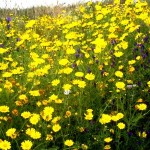
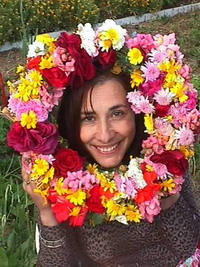 Many Athenians who have not gone home to their villages or to the islands will go up to Mount Parnitha or somewhere in the countryside surrounding Athens. After their meal some people pick wildflowers and make wreaths like Loula, wife of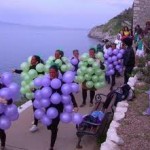













 Gamla Stan is one of the largest and best preserved medieval city centers in Europe, and one of the foremost attractions in Stockholm. This is where Stockholm was founded in 1252.

 Skansen Open-Air Museum
 Fotografiska
 The City Hall
 Moderna Museet
 National Museum


 Most bars and nightclubs are open until around 3 am. All restaurants, bars and nightclubs in Norway are smoke-free indoors but often have a sheltered smoking area outside.